
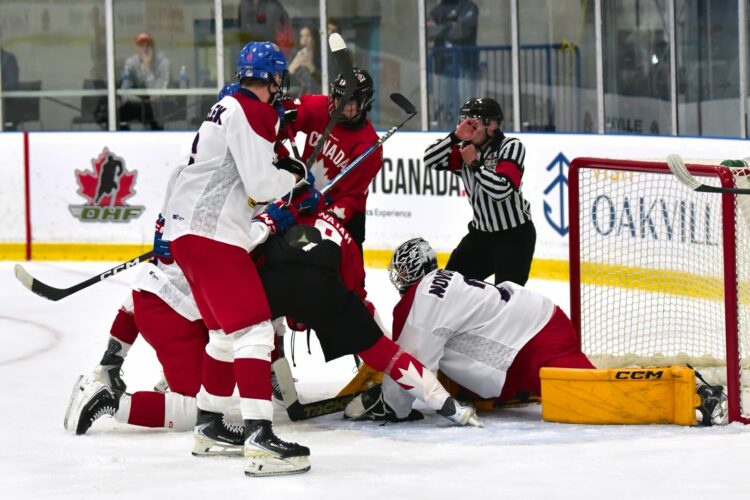
Over the course of last week, I spent a few days hanging out at the 2026 U17 World Hockey Challenge in Oakville, Ontario. While the U20 World Championship (better known as the World Juniors) is the prospect tournament of choice for the average hockey fan in Canada, this tournament can sometimes be the best way to see future NHLers stand out at an international tournament.
With the World Juniors, a top draft-year prospect can often be pushed down or out of a top country’s depth chart by older, post-draft players still hanging around major junior or a secondary level, and by the time they’re ready to be the veteran, they’re too busy playing in the NHL. In this tournament, everyone is still a year removed from being drafted, so Canada, the United States, Sweden, Finland, and Czechia tend to send their best, barring health. Canada even sends two teams!
While I wasn’t here for the full tournament, I did come out for the second day of Round Robins, the quarter-finals, and the semi-finals – so six of the eleven games, seeing five of the six teams at least twice (sorry, Czechia). Here are a few takeaways from every game:
Tuesday – United States 13, Finland 1
- Quick Summary: A game that wasn’t even close from the start. I turned around to the other media members within the first two minutes, with the score still at 0-0, and declared the game a certain blowout. The United States just looked that much faster and more comfortable with the puck. It took seven minutes for someone to score, but once the United States broke the ice, there was no turning back.
- Every so often you find a player who leaves an instant impression on you, and that was Jack Trupiano. The top point-getter on that insane 15U Little Caesars team from last year, you could see his elite-level shot in just his first couple of touches. Not only did he score that aforementioned first goal, he picked up two more and added another three assists in this game. Between his wicked release and his nose for the net, it’s no surprise there’s such a buzz around him.
- Joey Cullen, related to basically every Cullen you’ve ever heard of in hockey, is considered the main man to watch for the United States in this tournament and a serious threat to land near the top of the 2028 draft. You could see why in this game, making all sorts of quick plays on and off the puck to make things happen for his team. His 3-0 goal, where he shifted from pulling in most in Finland’s defenders with his own stickhandling, to finding freshly open space after he’d passed the puck, was a prime example of this, as was a toe-drag-and-dish effort on the 8-1 goal.
- You kind of had to feel bad for Finland’s goaltenders and the end of this one. I was wondering when the pull would come for Onni Temberg by the fourth goal, though given that Sami Sinkko’s night didn’t go dramatically better, it was probably fair to keep him in for the rest of the first. InStat had the United States generating 43 scoring chance-level attempts, which fleshes with the eye test. You can only expect so much from the goaltenders when your opponent is globetrottering their way into danger areas.
- I was excited to see Hannu Packalen in this tournament for Finland, as he’s a very familiar face to me, being from Kingston with Finnish heritage and a player I got to see quite a fair bit over last summer. This meant he’d be a good measuring stick for me to have an idea of where his other teammates stood in reference to him. So in a way, seeing him be the best Finn in this game was a little bittersweet. I was happy for him, but it also made me a little unsure of the rest of the group. Packalen, an Ottawa 67s pick currently playing in the CCHL, loves to play off the rush and has a good shot when left open. His skating is an area he should want to improve to become a true top-end talent, but the upside’s there.
- Drew Daley was also very good in this one. Everyone loves a smooth-skating, right-handed defenceman these days, and the New Yorker definitely fits the bill, scoring a goal off his own rebound after sneaking in from his own point in the first period. His puck protection was very noticeable in this game, shielding away threats as he made decisions on plays.
The United States went on to win the Gold Medal on Saturday – alas, I wasn’t around for the medal games.
Tuesday – Canada White 7, Sweden 2
- Quick Summary: The Swedes began this game trying to throw Canada White off theirs, and for a while it felt like it would work, but once we got to the late stages of the first period it was cruise control for the half-hosts.
- This is my first time seeing Maddox Schultz in person. I had some familiarity with him, due to his unique split of WHL and U18 minutes last year, making it possible for the U18 team was/am with to have faced them had we qualified for the TELUS Cup. I had an understanding that he was extremely good. My expectations were somehow exceeded, as he was an absolute monster all over the ice. Whether it was an air raid of shots, slippery passing, or responsible two-way play, he brought immense gravity to every shift. His dazzling keep-in and setup on the 6-1 Canada goal was one of the highlights of the week. This is the best player in the 2028 NHL Draft, a future NHL superstar. There is no question in my mind.
- Kane Cloutier went first overall in the OHL Draft this year, and there was a lot of debate going on as to whether he was truly the best player on the board, or the best positional fit that would report to Oshawa. His start to the season – just five points in sixteen games – has been a little underwhelming as well, not helping the conversation. But he looked very good to kick off this tournament, and while I don’t know if he would’ve received the Player of the Game honours if I had the choice, he was certainly high up the ranks. Cloutier, son of Dan, was explosive on his feet and made an awesome wraparound play on the second Canada goal, nearly scoring on the doorstep and quickly lapping back around to tap in the second effort.
- Jace Voortman was the lowest-drafted player on this Canada White team, and you wouldn’t know it from the effort he put in. He battled for every puck in all areas of the ice and was rewarded with a goal and two assists. Canada White head coach Dylan Smoskowitz was glowing about him whenever asked throughout the tournament, and it’s not difficult to see why. I liked him a lot in the games I saw of him with the Junior Canadiens and can see him translating into a difference maker in the OHL and beyond.
- Sweden didn’t really do much for me in this game individually. I did like that they tried to get under Canada’s skin off the hop, but their actual play-making wasn’t much to write home about. If there was a standout for me, it was Wilson Boumedienne, brother of Sascha and son of Josef. Funny enough, this is another case of the best player on the losing team not currently playing in the same country as they represent, as Boumedienne came through the American system and currently plays in the USHL. I felt he skated very well and created some initial opportunities for the Swedes but rarely had anyone to help him as he’d embark on danger areas.
- Milo Spelkvist was probably the best example of flash but no impact in this entire tournament. He had my attention early with a dazzling move that he couldn’t follow up on, and that seemed to be a reoccurring pattern not just in this game, but when I saw him on Thursday as well. It’s nice to see players show high-end talent, but there wasn’t really a sense of awareness or sandpaper to go with it that would have you coming back for more.
Thursday – Canada Red vs. Sweden
- Quick Summary: Opting for a more technical game against Canada Red didn’t lead to a significantly better result for Tre Kronor – instead we got a slow boil that saw Canada pick their opponents apart.
- Going back to big names from that Regina Pats split-team, I was really interested in what Liam Pue would bring in this tournament. Out of the gate, he did not excite me in the way that Schultz did. This isn’t to say that he wasn’t involved – he took more shots and attempts than any other Canadian in this game, and you could see that his toolbox was there, but the finishing touches weren’t there on most of his plays in this game. His goal was a long-distance empty netter, so it’s hard to give it too much weight.
- I loved Landon Roulston in this game. He’s a guy I’ve had some familiarity with for a bit, as he played two years of U16 in the GTHL (as an underager with the Marlies, and his draft year with Vaughan). His size, pace, and tenacity will help him slot into any program he ends up with along his journey towards pro hockey. He was rewarded for his efforts on Canada’s fifth goal, intercepting a questionable puck play by Leon Irani and ripping a breakaway wrister.
- Isak Alvudd was the lone goal scorer for Sweden in this one, finishing off a 2-on-1 rush just a minute and change into the game with a punchy snapshot. If there was a player who I felt gave the Swedes their biggest fight in this game, it was probably Melker Wersall, who was very active in transition in the first few periods and set up a couple scoring chances, though he was ultimately not rewarded for it.
- Owen Loftus is another two-year U16 player on this team, playing 2025 with the Mississauga Reps and last year with the Don Mills Flyers, and has arguably the highest pedigree of any of the Canadian goalies in this tournament. While Sweden didn’t create a ton of danger in this game, he completely shut the door after the Alvuud goal, rising to the occasion when he needed to. Nights like this show why he was taken eleventh overall in an OHL draft where no other goalies went in the first two rounds.
- One of my favourite plays in this tournament came on Canada’s first goal. Lucas Matheson corralled a rolling puck off the faceoff, pivoted his body to shield off a Swedish forward at the point, then slid the puck Northwest to Kash Kwajah sitting wide open on the left red line. Matheson, who plays for the Barrie Colts was one of my favourite players in this tournament, showing quick thinking with the puck and stellar agility on his feet.
- I loved the Swedes pulling their goalie down four with eight and a half minutes to go. Nothing to lose, right?
- This was the game John Tavares and Gavin McKenna were spotted at – they were sitting directly under us. Shoutout to the Oakville crowd for being normal about it – they were definitely noticed, but the adults gave them space, with the occasional kid coming to bother them (mostly McKenna, as I assume seeing Tavares in Oakville is old news at this point) for a selfie or a signature.
Thursday – Canada White vs. Finland
- Quick Summary: One of the most fun games I’ve watched in person in a long time. Finland was hungry to prove the USA game was a hiccup and not their normal pattern, and borrowed some of the spunk that Sweden used out of the gate against Canada White. It didn’t work, but it kept them in a deeply unusal game that never truly saw one team run away completely.
- Madden Daneault is one of a handful of 2011s playing in this tournament, meaning that he’s eligible for the 2029 draft rather than the 2028. Daneault is more than just eligible, too – he’s the early favourite to go first overall in that draft class. Like Pue and Schultz, the WHL’s early draft process mean that he’s playing a split rookie season between the Kelowna Rockets and U18 Red Deer Chiefs – that’s a hefty commute between games! In any event, while he had already bagged a few points in previous games, his vision was on display in this one, finding seams with ease and picking up two assists. Friend of the blog Steven Ellis, who provided the header photo for this post, has a good writeup on Daneault here.
- Schultz was still the big dog in this one, picking up a hat trick and an assist. His most impressive play was on the 5-3 Canada goal, as he tracked back to break up a potential breakaway at the blue line following a teammate’s turnover, built up speed along the wing, got into space to pick up a feathered pass from Daneault, and drove to the net for yet another highlight reel goal.
- Another great Schultz goal was his hat trick tally, thanks to a great end-of-PK clear by Voortman and a great effort by Adrian Sgro out of the box to get to the corner, dangle around a couple Finnish defenders, and slip the puck to his streaking captain. Sgro is one of the highest-touted defencemen in his age group, so it’s funny to see his most dazzling play come in a moment where he had to play forward.
- Finland definitely watched the game after them on Tuesday for inspiration on how to approach Canada White. They took the pest efforts the Swedes started that game with and dialed them up to 100, whether it was goaltender Sami Sinkko coming out to taunt Schultz after a breakaway miss, huge celebrations after every goal even as they never had a lead, or throwing some extra oomph into every hit, an extra shove at every whistle. Elias Oksanen, who scored Finland’s fourth goal, was a player I noticed instigating this early, though the attitude spread across much of their lineup.
- You can argue that the strategy didn’t work given that Finland lost, but when you go from losing 13-1 to keeping a game against a similarly though opponent to two goals and drawing nine powerplays, that’s a hell of an improvement.
- One of the benefactors of those powerplays was Niilo Jokinen, an undersized forward who was actually born in South Africa. He picked up two goals, one by hanging around the doorstep on the man advantage, and another by throwing a wrist shot into traffic and through the legs of Zachary Lainessse.
- Jokinen’s nicest play, however, might have been a wing-to-wing pass to Liius Nurmi, who was another standout for the Finns. A fellow teamate in the Tappara program, Nurmi had the favour returned to him on this goal after setting up Jokinen’s first.
- Aamos Vahuaselka, who scored Finland’s final goal on an end-to-end rush in the first minute of the third period, was the Finns’ most (and arguably only) involved defenceman throughout the night, quarterbacking their powerplay and breaking up a couple Canadian scoring chances before making his standout play.
Friday – Czechia vs. Canada Red
- Quick Summary: A nail biter until the end, Canada found themselves chasing the game early and never managed to pull ahead against a Czechia team who had the best record in the round robins.
- This game showed me a little more of Liam Pue than the night before. He was slicing through the neutral zone with poise and while he didn’t take as many shots as Thursday, they were hitting the net – and in the third period, he hit the back of it with heavy snapshot from between the faceoff circles. He also assisted on both of Canada’s other goals, finding his targets in high-danger places.
- Someone who didn’t get on the scoresheet but I felt deserved a mention was Thomas Boisvert, whose brother Sasha I just watched play a pair of games for AHL Rockford a couple weeks ago. His work ethic was evident all week, using his mobility and work eithic to crash the net, bang bodies, and track back defensively. One of the only players on Canada who showed me something in every period I saw him – sometimes it doesn’t have to be high-ceiling plays that make you shine, it just has to be helping your team.
- Kash Kwajah somehow both gave me a little less than I expected over the two games I saw him, but still scored a goal in each by getting into high-danger positions. I’m not too stressed about not seeing his A++ game, as I’ve seen it may times before and feel he’s going to be one of the best Canadians from this age group. I also know I missed his best game of the tournament, where he picked up 2 goals and 2 assists against the United States.
- Dominik Zelezny, a 2011, immediately piqued my interest when I saw him on the Czech powerplay, showing great jump on his feet and patiently deciding on his move that led to the game’s opening goal. A second powerplay saw him even more in control, and it made me want to see him bring that energy to 5-on-5 play. With a minute and change remaining in the second period, he stripped Matheson, undressed Loftus, and slipped home the game’s second goal, blowing a kiss to the fans afterward. Immediately after Pue’s equalizer, he took the shot that Matayas Cutta turned into the game winner. Already playing U20 hockey in Czechia, this 15-year-old is a rockstar. I’m very curious to see where he lands in 2029.
- Matyas Michalek fired off eight shots and twelve total attempts from the point in this game. Standing at a whopping 6’4, the sixteen year old has already played some games in the Extraliga, the top men’s league in the nation. He’ll have a pro career with his combination of size and mobility.
- Canada still could have won this game, even with the Czechs having some players who rose to the occasion. Perhaps the biggest reason they didn’t was Matyas Novotny (yes, this team had two guys named Matyas, and two guys surnamed Novotny – not confusing at all). He was stellar in goal and made Canada work for every inch of their efforts.
Friday – USA, Canada White
- Quick Summary: A fairly high-event game, where goaltending proved a separator even if star performances weren’t as evident. Canada’s lone lead was brief, with much of the game’s action happening in the span of a minute.
- The standout in this game was, without much doubt, US goaltender Mason Martin. Canada peppered him in the first two periods, including with some high-quality chances, and he barely budged, stopping 44 of 46. Martin went in the eighth round of the OHL draft last year, but no doubt he’d have drawn more interest if he didn’t have his eyes set on the USNTDP, with whom he’s with this year.
- Jaden Licastro was my favourite defenceman of the 2026 OHL draft class – admittedly a bit of a hot take given that four blue liners were dafted ahead of him, but his smooth play with and without the puck made me an early fan. We’ll see how that called shot shakes out as he plays his career with the Soo Greyhounds, but just for tonight, he showed the upside I always tell people about, keeping Canada settled in his own end while getting them up the ice and into scoring chance situations.
- This was a quiet game for Schutlz and Daneault on the scoresheet, though the former did still pick up an assist. Process wise, both still created whatever looks they could, with Schultz leading the team in shots, controlled entries, and exits that I’d tracked, and only missing out on a shorthanded breakaway goal by the shaft of Martin’s stick. Shot attempts with Schultz on the ice at even strength were 45-11. Daneault had five shots on goal in the second period alone. You obviously want your stars to find a way, but I didn’t think this was a case of them not showing up.
- That element of “didn’t produce eye-popping numbers, but the process was good” felt true for the Americans’ star pair of Trupiano and Cullen as well, especially the latter. When he had the puck, he chose what was happening with it, best evidenced by his one-timer goal and a pass slipped to Carter Morris for a dirty dangle past Dylan Mingo.
- This was another big game for Drew Daley, who scored the game-winning goal and had the top shot attempt share of any American playing a regular shift, out-attempting Canada 30-17 in a game where Canada had an 83-76 edge overall.
Medal Round
As mentioned above, I wasn’t around for Saturday’s games – I had my U18’s to be with in the afternoon, and a Leafs loss to watch in the evening. But for those curious, Sweden won a barn-burner in the fifth place game against Finland, Canada Red got the best of White to take Bronze, and the United States smothered the Czechs en route to a 3-0 shutout win for Gold.
Postface
Something I’ve been meaning to do on this website, but have lagged behind on as I get the ball rolling on pro-level content, is posting a bit about what I’m seeing in the rinks at other levels of the game. While I’m not as job-tied to minor and junior hockey as I have been in previous years, I’m still working with one minor hockey team and doing a little bit of consulting at the junior level, and as such, still spend a lot of time bouncing around the rinks. It’s nice to stay involved, and those connections also afford me access to resources that get integrated into my Leafs and Marlies coverage.
My goal is to avoid the hyper-technicals in these posts. They aren’t going to be written for people with terminal scout brain, others do a very good job of that already, but rather for more casual observers who want a starting point to getting to know certain players and teams.
Keep an eye for more of these “I watched a game” / “I watched some games”-style posts as I have some time throughout the year. Ideally I’d like to center them around tournaments or a few games in a week-or-two’s span.
